VPN Termination
Added in version 3.1.0
The VPN Termination model was added to support overlay and service-style VPN use cases.
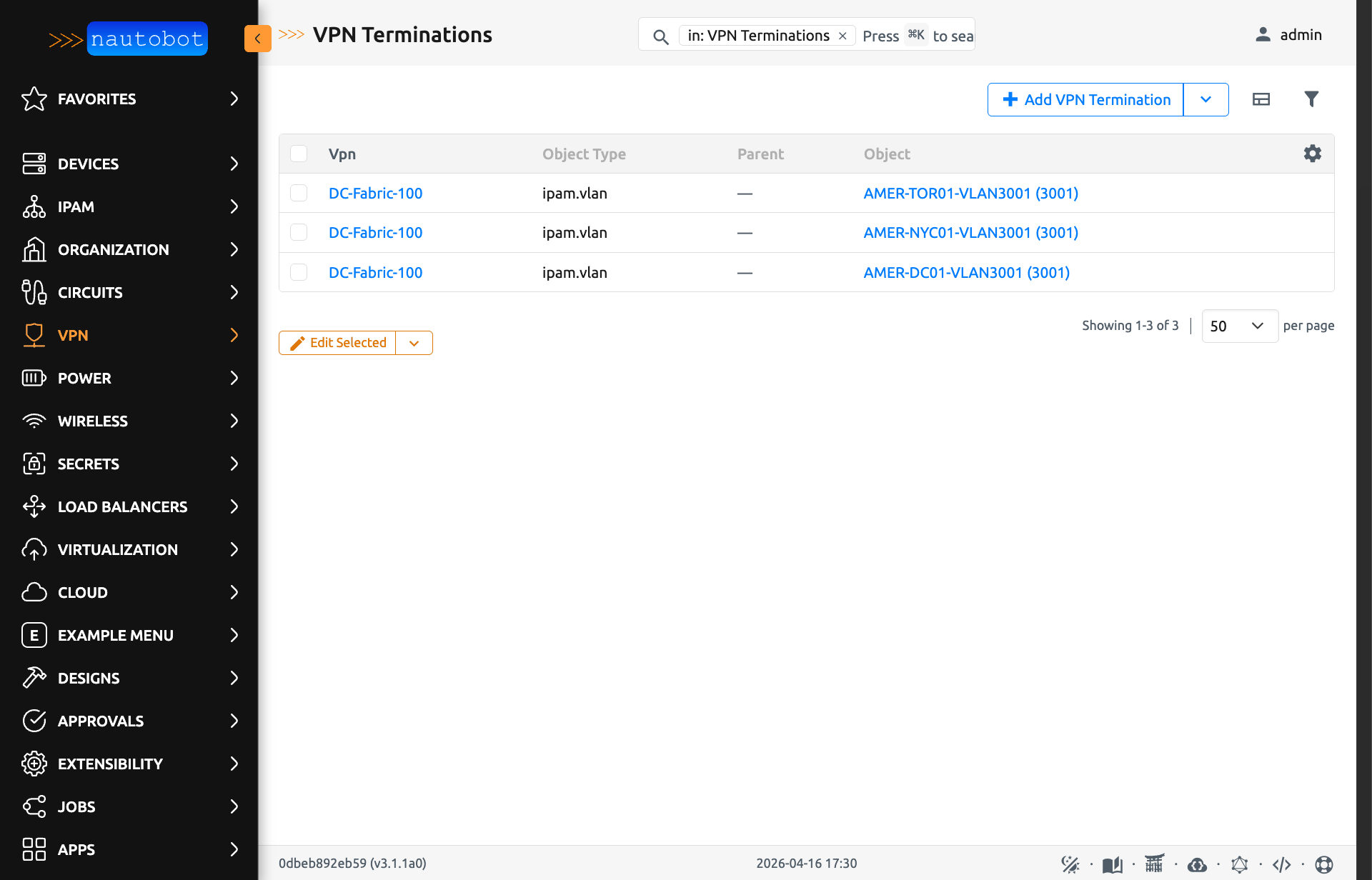
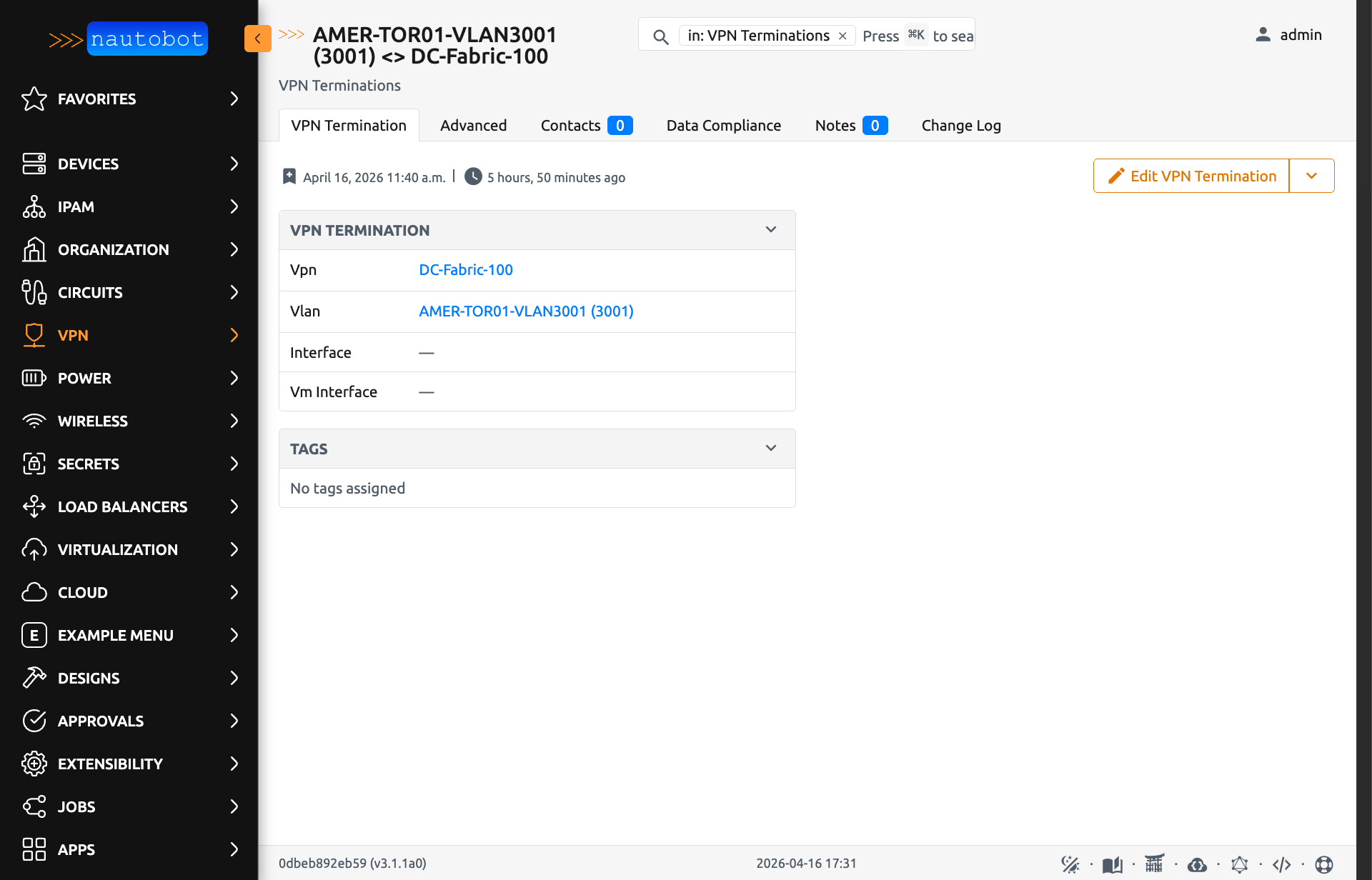
VPN Terminations associate a VPN service with exactly one local attachment point:
- a VLAN
- a device interface
- a virtual machine interface
This model is primarily intended for overlay and service-style VPN use cases where the VPN object describes the shared service and the VPNTermination records describe where that service is attached in the network.
For example, a VXLAN-based service can store its service-wide attributes on the VPN record, while individual VPNTermination records map that service to the relevant VLANs, switch interfaces, or VM interfaces that participate in it.
Note
VPN Terminations model overlay and service-style VPN attachment points (e.g. VXLAN, VPLS, E-Line). For tunnel-based VPN endpoints (e.g. IPSec, GRE, WireGuard), see VPN Tunnel Endpoint instead.
Validation Rules
Each VPN Termination must satisfy the following rules:
- Exactly one of
vlan,interface, orvm_interfacemust be set. - A given VLAN can belong to only one VPN Termination.
- A given device interface can belong to only one VPN Termination.
- A given VM interface can belong to only one VPN Termination.
- VPNs whose service type is point-to-point (VPWS, EVPN VPWS, EPL, EVPL) are limited to two terminations.
These rules help keep the attachment model unambiguous and make it clear which local object is bound to which VPN service.
Contextual UI Information
VPN Termination data is accessible from the following locations in the Nautobot UI:
- Under a VPN's detail view, in the Terminations table panel
- As a standalone list view under VPN > VPN Terminations
Use Cases
Common examples include:
- mapping a VXLAN or VXLAN-EVPN service to a VLAN
- associating a service directly with a routed or switched device interface
- associating a service with a VM interface in a virtualized environment
- modeling a point-to-point E-Line (EPL/EVPL) service between exactly two device interfaces
For detailed examples with diagrams, see Use Cases.